
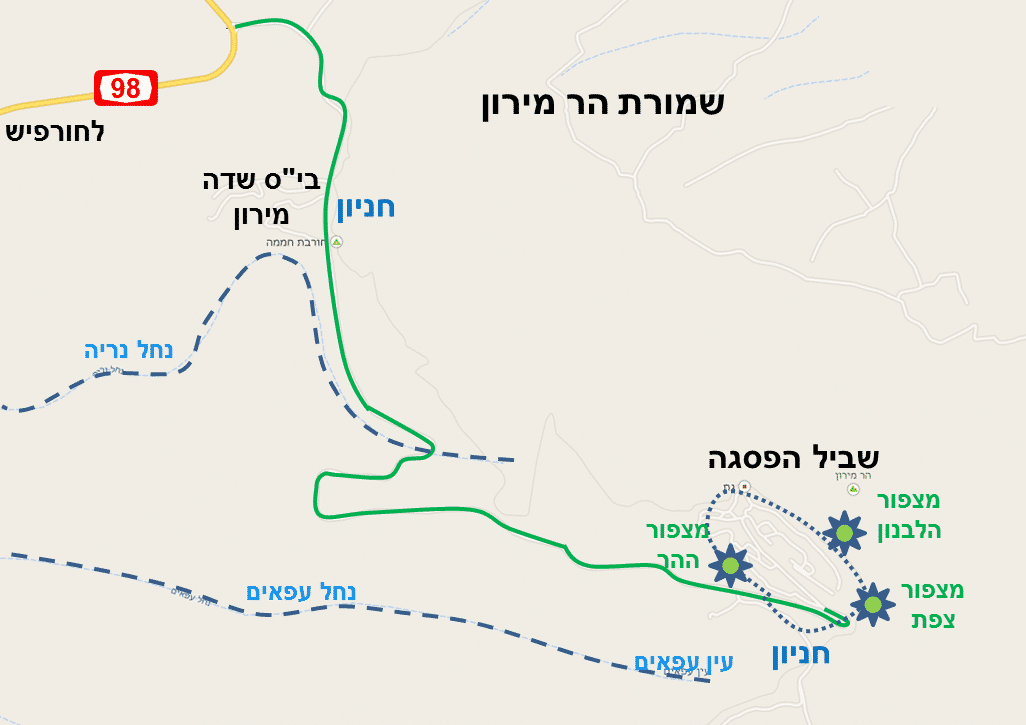
Three Observation Points on the Summit Path at Mount Meron
Thought, great expense, and hard work were invested by the Nature Reserves Authority in preparing the “Summit Path” on Mount Meron, a path of wonders that circles the peak of peaks of Mount Meron at an altitude of 1,200 meters and embraces its domes. This peak is the largest nature reserve in Israel, covering an area of about 100,000 dunams. The height of Mount Meron is 1,208 meters, and it is crowned by about ten additional peaks rising to a height of over 1,000 meters. The Mount Meron area is blessed with abundant precipitation and snow.
Limited Human Activity on Mount Meron for Hundreds of Years
 Limited human activity has preserved the primal nature of the mountain, the antiquity of its sites, its rare and beautiful vegetation, the flocks of birds nesting in the hidden recesses of its trees and bushes, and the unique reptile population found nowhere else in the country, such as the salamander and the newt.
We entered with a guide through the gates of the reserve into the sealed mountain kingdom of Mount Meron. It was a day of winter sun; we parked in the summit parking lot and began to ascend the Summit Path. Silence, birdsong, and the forest scents of falling leaves accompanied our steps between avenues of trees and plants. A rich world of vegetation is found here, including the Common Oak and the Boissier Oak, the Bear Plum and the Syrian Pear, the Phoenician Juniper, and the Service Tree (which is endangered), for which this is the only growing place in Israel. The world of flowers on Mount Meron is also multi-hued: cyclamen, the European Peony, the Giant Orchid, the Spotted Pink, Phoenician Juniper, and more. This is also the home and refuge of migratory wild animals: the marten, the edible dormouse, wild boars, and more.
Three observation points along the Summit Path on Mount Meron:
“Safed Lookout,” “Lebanon Lookout,” and “Mountain Lookout”—the lookouts reveal wonderful views to our eyes.
“Safed Lookout” – A wonderful view of the landscape expanses from the Sea of Galilee in the south to Mount Hermon and Manara in the north.
“Lebanon Lookout” – A view from Mount Hermon and Manara to Mount Adir, with the jagged peaks of Lebanon, snow-capped in winter, rising in between.
“Mountain Lookout” – A view of the Upper Kziv Stream, from Beit Jann to Hurfeish, and as far as the eye can see on a beautiful day, you can also see Mount Carmel on the right and Mount Tabor on the left.
Continuing our walk on the Summit Path
From here, four walnut trees are visible, now standing in their shedding phase, which were planted by Rabbi Israel Bak and his son Nissan. R.I. Bak, the printer from Berdychiv, settled in Safed in 1832 and also established the first agricultural farm in Jarmaq, which is Mount Meron. He received this village as a token of appreciation from Ibrahim Pasha. This village, whose fruits and crops gained a reputation, existed for only five years and was destroyed in the earthquake of 1837. From this fact, we learn that the pioneers of Jarmaq Mount Meron preceded the settlers of Gai Oni (Ja’una), which is today’s Rosh Pinna, and the settlers of Petah Tikva on the land of Melabbes. This also implies that the Mother of the Colonies is also Rosh Pinna. The guide points to the four walnut trees as the trees planted by Rabbi Israel Bak; these trees still tower today in the flat area, not far from the isolated house of the Druze guard Yusuf Effendi, who was murdered by Syrian intelligence agents. Bak’s walnut trees send us a living greeting from about 139 years ago. Today, at the foot of Mount Meron, there are sites holy to Jews and Druze. Among them are the tombs of the Tannaim, Rabbi Shimon bar Yochai and his son Rabbi Eleazar, Rabbi Yochanan HaSandlar, and also the tomb of Nebi Sabalan.
Hundreds and tens of thousands of young men and women visit the nature reserve on Mount Meron; because the path is level and comfortable, older people can also enjoy the sights and scents the mountain offers.
The path of wonders also brings us to an ancient Israeli winepress
A winepress where they trod the grapes with their feet. In the center is the round must pit, and the entire installation remains beautifully intact. The stonecutters carved into the rock, and the treading surface is ready for action; only the feet of the treaders have been replaced today by sophisticated devices and accessories in the technological era of the twentieth century. Therefore, there is no chance that the treading surface will be reactivated. An ancient majesty envelops the winepress, which sends us a tangible greeting from the activities of the Galilee farmers during the glory days of the people who sat securely on their land.
In the rainwater of the must pit, we also find a small salamander, its black skin shining and spotted with dark yellow dots. The guide strokes it with his hand and says with slight resentment: “All kinds of slander, superstitions, and false accusations are attributed to this cute creature; these are words of nonsense.” Indeed, the salamander has earned a complete rehabilitation from the mouth of one who is knowledgeable and authorized in the study of nature.
With love, diligence, and extraordinary effort, the people of the Nature Reserves Authority have prepared for us an educational site in the heart of nature that has no rival in our small country. It is easy to reach, and on the guided path, it is impossible to make a mistake or stray from the route. The square, low markers, cast in concrete and shaped like a four-pointed star, guard your steps. All those who feel stifled in their homes by the smells of gasoline and smoke emitted from city vehicles and various industries, and from the deafening noise, will find here a wonderful world of serenity that renews youth and the joy of life. It is fitting to honor the people of the nature reserve, the likes of which cannot be found anywhere else in nature, and for this, they deserve the Israel Prize for this care they show us.
As we descended from the summit of Mount Meron, the Hairy Rockrose, the Sage-leaved Rockrose, and the Winter Crocus greeted us as if in a parting blessing.
Written by Isaiah Ashani, Davar Newspaper, 1971